
Photon Energy Conversion Lab
Research Group at CUHK
Department of Electronic Engineering
STOLTERFOHT, Martin
Vice-Chancellor Associate Professor

Official homepage:
https://www.ee.cuhk.edu.hk/en-gb/people/academic-staff/professors/prof-stolterfoht-martinng
Martin Stolterfoht joined the Department of Electronic Engineering at the Chinese University of Hong Kong (CUHK) as a VC Early Career Associate Professor in August 2023. He obtained his Ph.D. at the University of Queensland, Australia in 2016 with a focus on charge transport and recombination in organic photovoltaics. From 2016 to 2019 he was a Postdoctoral Researcher at the University of Potsdam (UP), Germany with his primary research revolving around a fundamental investigation of recombination in perovskite solar cells through advanced optical and electro-optical characterization techniques and numerical simulations. From November 2019 until August 2023, he led the Potsdam Perovskite Research Group at UP, and in April 2022 he became a Heisenberg fellow funded by the German Research Foundation. During his career, he also visited the National Renewable Energy Laboratory (NREL) in the USA and the University of Oxford in the UK for extended research stays.
At CUHK he aims to bring the operational stability of perovskite solar cells to an industrial level (>20 years lifetime) via a global characterization of mobile ion-induced efficiency losses and their impact on device degradation. He also strives to develop a new generation of high-performance perovskite-based multijunction solar cells such as silicon/perovskite and all-perovskite and organic/perovskite tandem cells. His objective also includes establishing a fundamental description of thin film solar cell operation, charge transport, and recombination processes from picoseconds to steady-state through electro-optical measurements and numerical modeling.
Postdocs

Dr. TANG, Yangmin
I obtained my B.E. from Central South University and Ph.D. from the Shanghai Institute of Ceramics, Chinese Academy of Sciences (SICCAS) in 2025. I’m now a Postdoc in Martin’s group. My research focuses on perovskite-based X-ray detectors, aiming to develop high-performance and stable materials for next-generation radiation detection applications. Outside the lab, I enjoy swimming, dancing, and spending time with my cat.

Dr. LUKAS, Tino
Dr. Tino Lukas joined the Department of Electronic Engineering at the Chinese University of Hong Kong (CUHK) as a Postdoctoral Fellow in 2025. He earned his PhD in Physics from the University of Oxford, where he worked in Professor Henry Snaith's group. His PhD research focused on enhancing the stability of perovskite solar cells through interface and electrode design. At CUHK, Dr Lukas’s research focuses on advancing the operational stability of perovskite solar cells and their application in emerging energy technologies such as indoor photovoltaics.

Dr. XIE, Anzhi
Dr. XIE, Anzhi, Ph.D. from Sun Yat-sen University in 2025 and currently a Postdoctoral Fellow in Prof. Stolterfoht’s group. Research interests focus on efficient and stable monolithic perovskite/silicon tandem solar cells. Guided by DFT, current work explores doping strategies to tailor the optoelectronic properties of key functional layers and improve carrier-selective transport. The research also aims to develop stable wide-bandgap perovskite top cells through composition engineering

Dr. MEMON, Waqar Ali
Waqar Ali Memon obtained his Master's degree from the Beijing University of Chemical Technology in 2018 and his Ph.D. from the National Center for Nanoscience and Technology (NCNST), University of Chinese Academy of Sciences (UCAS) in 2023. Following his doctorate, he joined the Southern University of Science and Technology (SUSTech) as a Research Fellow from 2023 to 2025. Currently, he is a Postdoctoral Scholar at The Chinese University of Hong Kong (CUHK). His research primarily focuses on high-performance organic, perovskite, and tandem photovoltaics.

Dr. GUO, Wang
I am Wang GUO. I graduated with a Ph.D. in the Department of Biomedical Engineering at City University of Hong Kong.
I want to develop flexible, wireless tactile sensor integration with Perovskite Solar Cells that could enable self-powered, non-invasive, continuous monitoring electronic systems.
Research interest: optoelectronic devices, flexible sensors, system integration, and AI.
PhD students
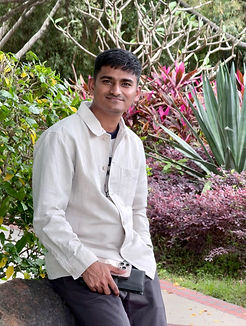
KALASARIYA,Nikhil Fulabhai
I am interested in advancing perovskite based tandem solar cells. I try to understand the stability limiting mechasnim, in particular characterizing ionic loss mechanisms and determining the evolution of the ion density during degration. In my first study, I have systematically explored the correlation between halide segregation, ion density evolution, and ionic loss evaluation, highlighting that these process occur concurrently at the same timescales. I currently work on identifying accerlated aging protocolls to predict the stability of perovskite-based tandem cells.

LIU, Ziwei
I am a Ph.D. student at The Chinese University of Hong Kong, specializing in wide-bandgap perovskite solar cells. My research focuses on understanding ion migration, electric field screening, and long-term operational stability in pure-iodide and mixed-halide systems. I employ multi-modal characterization techniques to investigate degradation mechanisms and interface engineering strategies. My goal is to develop stable, high-efficiency perovskite absorbers for tandem photovoltaic applications.

FENG, Qifan
Research centers on the operational stability of perovskite solar cells, quantifying how mobile-ion–induced efficiency losses accelerate device degradation. Integrated electrical and optical diagnostics map ion migration in the bulk and at critical interfaces, with findings distilled into practical design rules for long-term durability. This framework guides materials and stack engineering to suppress hysteresis and sustain output under electrical, thermal, and light stress. Building on this foundation, next-generation high-efficiency multijunctions are advanced, including silicon–perovskite tandems and all-perovskite architectures.

DONG, Yuxin
Yuxin received her bachelor's degree in Microelectronics from South China University of Technology in 2023. She is currently pursuing her Ph.D. degree in the Department of Electronics Engineering at CUHK. Her research interests mainly focus on hot carrier dynamics, carrier extraction, and next-generation photovoltaics.

SUN, Tian
My primary research interest focuses on perovskite optoelectronic devices, specifically photodetectors and solar cells. Currenty, I work on improving perovskite-based Xray detectors for low-dose radiation detectors and imaging applications. This includes single-crystals and large-area filsm.

LOU, Zhaoyu
I currently focus on the role of mobile ions and traps in some transient processes, like fast hysteresis characterization and bias-assisted charge extraction (BACE) measurement. And my research interests focus on investigation the physical process inside perovskite-based device and relate photoelectric characterization.I currently focus on the role of mobile ions and traps in some transient processes, like fast hysteresis characterization and bias-assisted charge extraction (BACE) measurement. And my research interests focus on investigation the physical process inside perovskite-based device and relate photoelectric characterization.

CHEN, Yanrong
My research focuses on perovskite-based tandem solar cells, particularly the design and development of high-efficiency PVK/PVK and PVK/Si tandem solar cells. I am committed to accelerating the development of perovskite tandem cells with improved stability by gaining deeper insights into degradation factors and devising novel strategies to extend cell lifetime.
HUANG, Zixuan

Zixuan comes from Guangdong, received his Master’s degree in Electronic and Information Engineering from Nankai University in 2024, where he worked under the supervision of Prof. Xiaodan Zhang. Following his Master's studies, he worked as a Perovskite R&D Engineer at Kibing New Energy Development (Shenzhen) Co., Ltd., focusing on large area single-junction perovskite solar modules. He joined the group in [10/2025]. His research interests include monolithic perovskite/silicon tandem solar cells and wide band gap perovskite photovoltaics.

CAO, Sijun
I graduated from Chongqing University with a bachelor's and master's degree. I come from Nujiang, Yunnan Province, and I am the Nu nation. My research direction is metal halides for X-ray imaging. In order to enhance the level of non-destructive testing in medical care, I plan to research the application of single-crystal perovskite in X-ray direct detectors.

YANG, Zitong
I am currently involved in a project using machine learning to find the hidden patterns behind the bandgap dependence and aging of perovskite solar cells (PSCs). My work focuses on training predictive models that can forecast 16 different material and device parameters from a single measurement, including factors like ion mobility, recombination rates, and energy level alignment. By applying these models to PSCs, I aim to gain deeper insights into the properties of these cells, improving their efficiency, stability, and durability.
Research Assistants
ZHAO, Bo

My research focuses on compound semiconductor optoelectronic devices, involving theoretical and experimental studies on device fabrication and photoelectric interaction mechanisms. Currently, I concentrate on polycrystalline perovskite X-ray detectors, covering material property optimization, large-area preparation, backend chip integration, and imaging performance research. My goal is to address key bottlenecks and advance their practical applications in medical imaging.

BHUNIA, Prithwish Kumar
I am Prithwish Kumar Bhunia. I am pursuing my Ph.D. at IISER Thiruvananthapuram, India. I have joined this laboratory as a Research Assistant. My goal is to develop efficient, pure-iodide wide-bandgap perovskite solar cells and determine the temperature coefficient and degradation rate at different temperatures. Furthermore, I aim to improve the Voc of pure-iodide devices through interfacial engineering.